
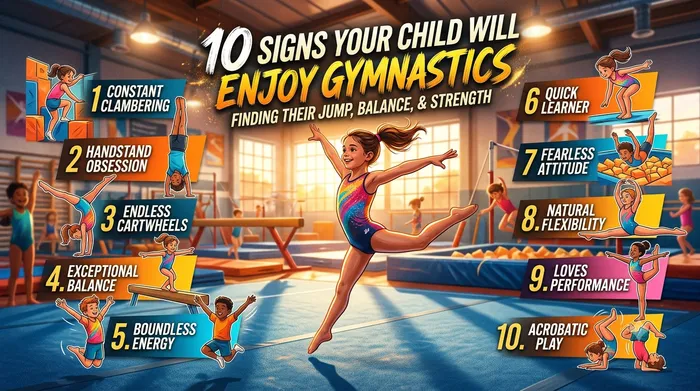
10 Signs Your Child Will Enjoy Gymnastics
Many parents wonder whether gymnastics will suit their child. Some children take to the mat immediately. Others need a few sessions to settle in. Certain personality traits and everyday behaviours often signal that a child is likely to enjoy gymnastics and stick with it.
This guide outlines ten clear signs that your child may thrive in gymnastics classes. These clues come from common patterns seen in active children who respond well to structured movement. Recognising them early helps parents choose activities that match natural energy and curiosity.
Quick note: No child needs to show every sign. Even three or four strong indicators can suggest a good fit. A trial class remains the most reliable way to confirm.
1. They Love Climbing, Jumping and Balancing
Children who constantly climb furniture, jump off steps or walk along low walls often have a natural affinity for gymnastics. These behaviours show comfort with height, balance and controlled risk.
Gymnastics channels that energy into safe, progressive skills. Instead of unsupervised climbing, children learn proper technique on beams, bars and floor. The activity feels like an extension of what they already enjoy.
2. They Have High Physical Energy
Some children seem to have an endless supply of movement. Sitting still for long periods is hard. They run, tumble or wrestle with siblings more than they sit quietly.
Gymnastics provides a structured outlet for that energy. Classes combine strength work, skill practice and short games so children leave feeling satisfied rather than restless. Among active child activities, gymnastics stands out because it uses the whole body in varied ways.
3. They Enjoy Learning New Physical Skills
Watch how your child reacts when they master something new, such as riding a bicycle, skipping or catching a ball. Do they light up and immediately want to try the next challenge?
Children with this trait often respond well to the skill-progression system in gymnastics. Each new roll, cartwheel progression or balance becomes a satisfying milestone. The sense of “I can do more than yesterday” keeps motivation high.
4. They Show Curiosity About How Their Body Moves
Some children experiment with movement. They try to do handstands against a wall, roll across the floor or twist into unusual shapes. They ask questions like “How do people do flips?”
This body curiosity is a strong gymnastics personality trait. Classes give them safe ways to explore strength, flexibility and control under guidance. The learning feels purposeful rather than random.
5. They Handle Mild Frustration Without Shutting Down
Gymnastics involves repeated attempts. A child may need several tries before a skill clicks. Children who can tolerate short moments of difficulty and try again usually adapt well.
If your child gets upset quickly when something is hard but recovers with encouragement, they are likely to benefit from the resilience practice built into good classes. Coaches support this process by breaking skills into smaller steps.
6. They Like Clear Structure and Routines
Children who feel comfortable with predictable sequences often settle quickly into gymnastics. Classes typically follow a familiar pattern: warm-up, skill stations, conditioning and a short game or cool-down.
If your child likes knowing what comes next and responds well to instructions, the structured format of gymnastics can feel reassuring. This is especially helpful for children who thrive when expectations are clear.
7. They Seek Physical Challenges Over Purely Quiet Play
Some children prefer active play to sitting with toys or screens for long stretches. They look for ways to test their strength or coordination.
Gymnastics offers progressive challenges that grow with the child. What feels difficult at first becomes achievable, and then a new goal appears. This ongoing sense of challenge keeps many children engaged for years.
8. They Respond Positively to Encouragement and Feedback
Children who light up when a parent or teacher notices their effort often do well in coached settings. Gymnastics provides frequent, specific feedback: “Your arms were straighter that time” or “You held the balance longer.”
Positive, skill-focused attention helps these children feel seen and capable. Over time they learn to value their own progress rather than only external praise.
9. They Enjoy Being Part of a Small Group
While some children prefer one-on-one attention, many thrive in small groups where they can watch peers, offer encouragement and share small successes. Gymnastics batches of eight to fourteen students create this balance.
If your child enjoys playground games or group activities at school, they are likely to appreciate the social side of class. Friendships often form around shared effort on the floor.
10. They Recover Quickly and Want to Try Again
After a fall, a missed attempt or a wobbly landing, some children get up and go straight back to the skill. This bounce-back tendency is one of the clearest signs a child will enjoy gymnastics.
Resilience grows with practice, yet children who already show a basic willingness to try again usually find the learning process rewarding rather than discouraging.
How These Signs Connect to Real Progress
Children who display several of these gymnastics personality traits often progress steadily because the activity matches their natural preferences. They experience more moments of success, which builds confidence. Confidence then encourages them to attempt the next skill.
Parents sometimes worry that a child must already be flexible or strong. In reality, those qualities develop through training. Enjoyment and willingness to practise matter more at the beginning.
What to Do If You Recognise These Signs
- Observe your child in free play for a few days and note which behaviours appear most often.
- Look for a centre that offers age-appropriate classes and small batches.
- Book a trial class so your child can experience the environment directly.
- Speak with the coach afterwards about how your child responded.
- Give the activity a fair trial of several sessions before deciding.
Many families in Bangalore find that structured gymnastics programmes provide the right mix of physical challenge, clear progression and supportive coaching. You can explore age-group options on the programmes page and see details for school-age children on the kids gymnastics page.
Current class timings appear on the schedule page. Common questions about starting, fees and what to expect are answered on the FAQ page. To arrange a trial or ask about your child’s specific stage, use the contact page. Further background on the coaching approach is available on the about page.
When the Signs Are Less Obvious
Not every child who enjoys gymnastics shows all ten signs from the start. Some children are quieter or more cautious at first and grow into the activity. Others discover they love it only after a few sessions.
If your child is generally active and curious about movement, a well-run trial class is still worthwhile. Coaches experienced with beginners can often spot potential even when parents are unsure.
Conclusion
Recognising the signs your child likes gymnastics helps you choose activities that match their natural energy and personality. Children who climb, jump, seek physical challenges, handle mild frustration and respond to structure often find gymnastics both enjoyable and rewarding.
Among active child activities, gymnastics offers a rare combination of strength, coordination, flexibility, focus and measurable progress. When the environment is safe, the coaching is patient and the groups are small, children with these traits usually thrive.
Watch for the clues in everyday play, then give your child the chance to try a class. The right match between personality and activity creates the best foundation for lasting confidence and physical development.