
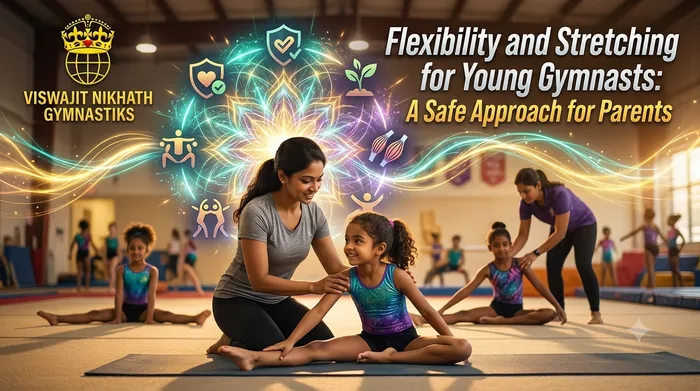
Watch any gymnastics class for five minutes and you'll notice it: the effortless-looking splits, the deep backbends, the way kids seem to fold in half without a second thought. It's easy to assume flexibility like that is either something a child is simply born with, or something achieved through pushing hard and hoping for the best. Neither is quite right, and the difference matters, especially when it's your own child on the mat.
Flexibility in gymnastics isn't a party trick. It's a trained physical quality, built gradually and safely, the same way strength or balance is. Here's what parents should actually know about how it works, and how to tell good stretching practice from something that could do more harm than good.
Why Flexibility Matters in Gymnastics
Flexibility isn't just about looking impressive in a split. It plays a functional role in almost everything a gymnast does:
- Injury prevention - a joint with a healthy range of motion is less likely to strain when a skill doesn't land perfectly
- Better technique - skills like leaps, bridges, and certain floor elements are simply not achievable without adequate flexibility
- Efficient movement - flexible muscles use energy more efficiently through a full range of motion, which supports stamina over a long class
- Long-term physical development - the mobility habits built in childhood tend to carry into adolescence and adulthood far more easily than mobility gained later in life
In other words, flexibility training isn't separate from "real" gymnastics. It's one of the foundations everything else is built on.
How Flexibility Should Actually Be Trained in Kids
Good coaches don't chase flexibility through force. The safe, effective approach looks more like this:
- A proper warm-up first - stretching cold muscles is one of the most common ways young athletes get hurt, in any sport
- Gradual, consistent progress - small, regular gains over weeks and months, not one dramatic session
- A mix of stretch types - dynamic stretching (controlled movement) before activity, static stretching (held positions) afterward, when muscles are warm
- No forcing or bouncing - a coach should never push a child's leg or back further than it comfortably goes; range of motion should be earned, not forced
- Individual pacing - every child's natural flexibility differs, and a good programme respects that instead of comparing kids to each other
If you ever see a coach physically pushing a child into a deeper stretch than they can hold on their own, that's a red flag worth raising, not something to brush off as "normal training."
What Safe Stretching Looks Like, by Age
| Age Group | Focus | What to Expect |
|---|---|---|
| 2-4 years | Playful mobility through games, not formal stretching | Short, fun movement patterns, no held stretches |
| 5-8 years | Introduction to basic static stretches, always after warm-up | Gentle holds of 10-20 seconds, guided by a coach |
| 9-14 years | Structured flexibility routines tied to specific skills | Longer holds, split progressions, active mobility work |
| Teens/Adults | Maintenance and targeted flexibility for specific goals | Consistent routines, often self-guided with coach check-ins |
No age group should involve a coach or parent applying external pressure to force a deeper stretch. Progress should come from the child's own muscles relaxing over time, supported by consistency rather than intensity.
Signs Flexibility Training Is Being Done Right
- Your child isn't in pain after class, mild muscle fatigue is normal, sharp pain is not
- Stretching always happens after a warm-up, never as the very first thing in class
- Coaches explain what a stretch is for, not just instruct kids to hold a position
- Progress is measured in small increments over weeks, not forced in a single session
- Your child feels encouraged rather than embarrassed about their current flexibility level
Frequently Asked Questions
Is it safe for young children to do splits?
Yes, when built up gradually through consistent, age-appropriate stretching and never forced. Children's connective tissue is naturally more pliable than adults', but that doesn't mean it should be pushed hard. Safe progress happens over weeks and months, with a proper warm-up every time.
At what age should a child start flexibility training in gymnastics?
Formal, structured stretching usually begins gently around age 5, once a child can follow instructions and hold a position with control. Younger toddlers build mobility more through playful movement than deliberate stretching.
Can flexibility training help outside of gymnastics too?
Definitely. Better mobility supports performance and injury prevention in almost every other sport a child might take up later, along with everyday movement, posture, and comfort as they grow.
Should my child stretch at home between classes?
Light, gentle stretching at home can help, but only with proper form and never forced. If you're unsure what's appropriate for your child's current level, it's best to ask their coach for a few safe exercises rather than guessing.
How long does it take for a child to become flexible?
It varies widely by child, but consistent, twice-weekly stretching as part of regular gymnastics classes typically shows noticeable improvement within a few months. Flexibility built slowly and safely also tends to last, unlike gains forced too quickly.
Flexibility is one of those things that looks effortless from the outside and is anything but. Done properly, it's one of the safest, most valuable parts of a young gymnast's training, and a good sign that a programme is coaching for the long term, not just for a good-looking photo.