
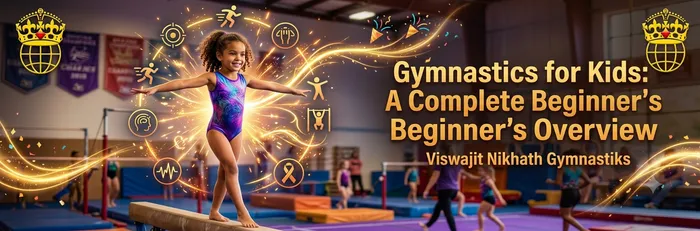
If you've been searching "gymnastics for kids" and coming up with a lot of scattered information, you're not alone. Most parents arrive at this question after hearing that gymnastics builds strong, confident, coordinated children, but few sources actually explain what the sport looks like day to day, or how to know if it's the right fit for your child. This guide is meant to be that starting point: a single, complete overview of gymnastics for kids, written for parents who are just beginning to explore it.
What Is Gymnastics for Kids, Exactly?
At its core, kids' gymnastics is a structured program that teaches children how to move their own bodies with strength, control, and confidence. It's built around a handful of core skill areas:
- Floor movement: rolls, cartwheels, jumps, and balance work that form the foundation for everything else
- Strength and body control: age-appropriate conditioning that builds core, arm, and leg strength safely
- Flexibility: guided stretching that improves range of motion without forcing it
- Apparatus introduction: depending on age and level, gentle first exposure to equipment like beams, bars, and vaults
- Coordination and spatial awareness: learning how the body moves through space, which carries over into almost every other sport
Unlike many other activities, gymnastics doesn't require your child to have any prior experience or natural talent to begin. Classes are structured in levels, so a five-year-old trying gymnastics for the very first time and a nine-year-old with a year of experience are both working at a pace that suits them.
Why Parents Choose Gymnastics for Their Kids
Gymnastics is often described as a foundational sport, and for good reason. The strength, balance, and coordination it builds tend to transfer well into other sports children take up later, whether that's swimming, football, or dance. Beyond the physical side, most parents notice a few other things fairly quickly:
- Confidence grows visibly. Mastering a new skill, even something as small as a forward roll done correctly, gives kids a real sense of achievement they can see and feel.
- Discipline comes naturally. Following instructions, waiting a turn, and practising a skill repeatedly until it clicks are built into every class.
- It's genuinely fun. Because sessions are movement-based and often playful, kids rarely experience it as exercise the way they might view a straightforward fitness routine.
- It suits a wide range of personalities. Energetic children get a safe outlet for their energy, while shy or cautious children often build confidence at their own pace, without the pressure of a team sport.
What Age Should a Child Start?
There isn't a single correct age, but most academies, including ours, welcome children from around 3 years old in toddler-focused programs, moving into structured kids' classes from roughly age 5 or 6 onward. Younger children benefit from shorter, play-based sessions focused on basic movement and following instructions, while older beginners can usually pick up structured skills more quickly. If your child is older and just starting out, that's completely fine too; gymnastics doesn't have a strict window, and beginner classes are designed to meet children wherever they are.
What a Typical Class Looks Like
A well-run kids' gymnastics class usually follows a consistent structure, which helps children feel secure and know what to expect:
- Warm-up: light movement and stretching to prepare the body
- Skill stations: rotating through different activities (floor, basic apparatus, conditioning) in small groups
- Guided practice: a coach demonstrating and correcting technique one-on-one or in small groups
- Cool-down and recap: finishing with lighter movement and often a quick recap of what was learned
Classes are supervised closely, with coaches trained to spot and correct technique before habits form incorrectly, and to keep the environment safe as children attempt new skills.
How to Get Started
If you're considering gymnastics for your child, a good first step is simply booking a trial class. This lets you see the facility, meet the coaches, and, most importantly, watch how your child responds to the environment before committing to a full program. Look for a few basics when evaluating any academy:
- Coaches trained specifically in child gymnastics, not just general fitness
- Proper matting and equipment suited to beginner skill levels
- Small enough class sizes that each child gets individual attention
- A clear, age-appropriate curriculum rather than an unstructured free-for-all
Frequently Asked Questions
Is gymnastics safe for young kids?
Yes, when it's taught by trained coaches in a properly equipped facility. Beginner classes focus on foundational movement and controlled progressions, with coaches closely supervising every skill attempt and adjusting pace to each child's ability.
Does my child need to be flexible or athletic to start gymnastics?
Not at all. Flexibility, strength, and coordination are things gymnastics builds over time, not prerequisites for joining. Most children who start have no prior experience, and classes are designed to develop these qualities gradually.
How many classes per week are recommended for beginners?
Most beginners do well with one to two classes a week. This gives enough consistency to build skills and confidence without overwhelming a young child, especially alongside school and other activities.
What should my child wear to their first gymnastics class?
Comfortable, fitted athletic wear works best: form-fitting tops and stretchy shorts or leggings that won't get caught in equipment. Bare feet or gymnastics socks are standard, and loose jewellery should be left at home.
How long before I see progress?
Many parents notice improved balance, body awareness, and confidence within the first few weeks. More visible skills, like a controlled cartwheel or a held handstand, typically develop over a few months of consistent practice.
A Great Foundation, Whenever You're Ready
Gymnastics for kids isn't about producing future champions, though for some children, that path opens up naturally. For most families, it's simply one of the most complete foundations a child can get: strength, flexibility, coordination, and confidence, all built through movement that feels like play. If you've been on the fence about where to start, a trial class is a low-pressure way to see it for yourself.