
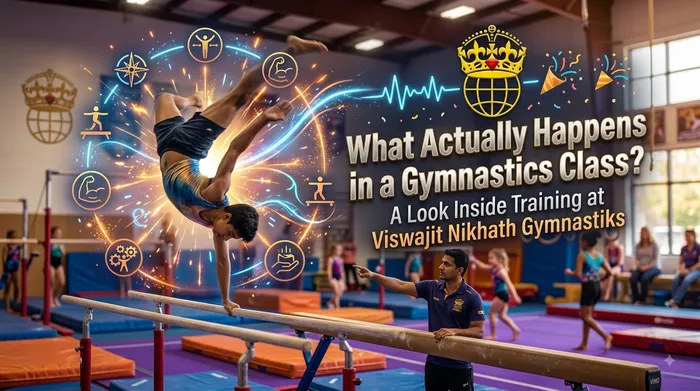
If you've never set foot inside a gymnastics facility, it's hard to picture what an hour of "gymnastics training" actually involves beyond cartwheels and the occasional split. Parents searching for gymnastics training near me or gymnastics training in Bangalore are usually picturing something between a dance class and a circus act, and the reality is both more structured and more interesting than that.
At Viswajit Nikhath Gymnastiks, every class - whether it's a toddler's first session or a pre-competitive athlete's evening practice - follows the same underlying shape. Understanding that shape helps parents know what to expect, why certain drills repeat week after week, and how to tell a properly run session from one that's just free play with mats.
The Four Phases of a Gymnastics Class
No matter the age group, real gymnastics training moves through four phases. The time spent in each shifts as gymnasts get older and more skilled, but none of them ever gets skipped.
- Warm-up (10-15 minutes): Light cardio, joint mobility, and dynamic stretching to raise body temperature and prepare muscles and ligaments for load. This is non-negotiable - most gymnastics injuries happen when a cold body attempts a skill it wasn't ready for.
- Conditioning (10-20 minutes): Bodyweight strength work - hollow holds, planks, leg lifts, wrist and shoulder prep - built specifically around the demands of gymnastics rather than generic fitness. A young gymnast's strength-to-bodyweight ratio is what eventually makes skills like a handstand or a cartwheel look effortless.
- Skill stations (20-30 minutes): Rotating through apparatus or skill groups - floor, beam, bars, vault, depending on age and level - with a coach actively spotting, correcting, and progressing each gymnast individually rather than running one drill for the whole group.
- Cool-down and flexibility (5-10 minutes): Static stretching and a brief recap of what was covered, which also gives coaches a moment to flag anything a parent should know before pickup.
How This Looks Different by Age Group
The four-phase structure stays constant, but the balance between phases and the specific drills change a great deal depending on who's in the room.
| Age group | Typical session length | What gets the most time | Coaching style |
|---|---|---|---|
| Toddlers (2-4 yrs) | 30-40 minutes | Play-based movement, balance, following instructions | High adult-to-child ratio, lots of hands-on guidance |
| Recreational kids (5-12 yrs) | 45-60 minutes | Skill stations across apparatus | Small groups, individual correction and spotting |
| Pre-competitive / competitive | 90+ minutes | Conditioning and repetition of specific skills | One-on-one attention on named skills, video review |
| Adults | 45-60 minutes | Strength, flexibility, foundational skills | Judgment-free pacing, modified progressions |
What doesn't change across any row of that table is the presence of a qualified coach actively watching every attempt. Gymnastics is one of the few sports where a missed spot can mean a serious fall, so real training always has more supervision per gymnast than a typical group fitness class.
Why the Repetition Matters
Parents sometimes ask why their child seems to "do the same thing" every week. Gymnastics skills are built on a strict foundation - a proper handstand needs the shoulder, core, and wrist strength developed in conditioning; a proper cartwheel needs the spatial awareness built in earlier balance drills. Coaches deliberately revisit foundational movements even after a gymnast can technically perform the next skill, because a shaky foundation shows up as a plateau (or an injury) later on. This is also why gymnastics training tends to build visible confidence and body control faster than sports where kids jump straight into full plays or routines.
What a Good Facility Should Show You
If you're evaluating gymnastics training options in Bangalore, ask to observe a class before enrolling. In a well-run session you should be able to see:
- A warm-up that happens before any apparatus work, every single class.
- Coaches physically spotting gymnasts on new or difficult skills, not just calling out instructions from the side.
- Small enough groups that no child is left waiting more than a minute or two between turns.
- Age-appropriate equipment - toddler-sized beams and soft landing mats for younger kids, not adult apparatus scaled down.
- A cool-down at the end, not a sudden stop when time runs out.
If any of these are consistently missing, it's worth asking the facility directly how their sessions are structured.
Frequently Asked Questions
How long is a typical gymnastics training session?
Most recreational classes run 45 to 60 minutes, toddler sessions run shorter at 30 to 40 minutes, and pre-competitive or competitive training can extend to 90 minutes or more as gymnasts take on higher training volume.
Is gymnastics training safe for beginners?
Yes, when it's properly structured. A real beginner session spends more time on warm-up, basic conditioning, and coach-supervised progressions than on advanced skills, which is exactly what keeps early training safe.
Do gymnasts need to be flexible before starting training?
No. Flexibility is something training builds over time through consistent stretching, not a prerequisite to walk in with. Most beginners start with average flexibility and improve steadily within a few months.
How often should a child train to see progress?
Most recreational gymnasts train one to three times a week. Consistency matters more than frequency at the start - a child attending one class every week will make steadier progress than one attending three classes sporadically.
What should I look for when comparing gymnastics training in Bangalore?
Watch a live class if you can, and specifically look for active spotting, small group sizes, age-appropriate equipment, and a clear warm-up-to-cool-down structure rather than judging on the facility's size or decor alone.
If you'd like to see this structure in action, you're welcome to drop by Viswajit Nikhath Gymnastiks and watch a session before deciding - it's the fastest way to tell real gymnastics training apart from a rough approximation of it.