
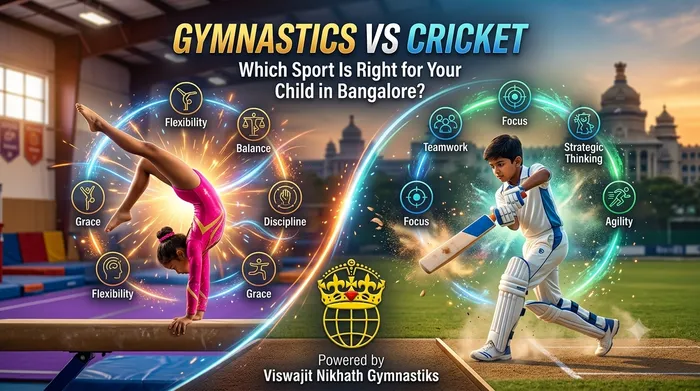
If you're raising a child in Bangalore, chances are cricket has already found its way into your living room, your child's school PE periods, or the empty lot down the road. It's the sport most Indian kids are handed a bat for first, often without anyone stopping to ask whether it's actually the best starting point for a growing body. Gymnastics, meanwhile, rarely gets considered in the same breath, even though it may do more for a young child's overall athletic foundation than almost any other sport.
At Viswajit Nikhath Gymnastiks, we're not here to tell you cricket is a bad choice; it isn't. But we do think parents deserve a clear, honest comparison before choosing where to spend a child's after-school hours. Here's how the two actually stack up.
What Gymnastics Builds
Gymnastics is built around mastering your own bodyweight. From the very first class, children work on:
- Full-body strength - arms, core and legs all get used, not just the dominant side
- Flexibility - safe, progressive stretching that keeps joints healthy long-term
- Balance and coordination - the foundation every other sport (including cricket) draws on
- Body awareness - knowing exactly where your limbs are in space, which sharply reduces fall-related injuries in daily life
- Discipline and focus - each new skill is broken into small, achievable steps, teaching patience and persistence
Because gymnastics is individual, every child progresses at their own pace. A shy child isn't waiting to be picked for a team; a confident child isn't held back by a slower teammate.
What Cricket Builds
Cricket brings its own, very real strengths:
- Team coordination - understanding roles, communication, and shared responsibility for a result
- Hand-eye coordination - particularly for batting and fielding
- Strategic thinking - reading the game, adapting to a bowler or batter in real time
- Social bonding - the dressing-room camaraderie many adults still remember fondly
- Cultural connection - cricket is woven into Bangalore's identity, from gully games to the RCB matches families watch together
The tradeoff is that cricket is a specialised sport: it develops specific movement patterns (throwing, batting stance, running between wickets) rather than an all-round physical base, and a lot of match time is spent waiting rather than moving.
Side-by-Side Comparison
| Gymnastics | Cricket | |
|---|---|---|
| Format | Individual | Team |
| Best starting age | As young as 2-3 (toddler classes) | Typically 6-7 onward |
| Physical development | Full-body strength, flexibility, balance | Hand-eye coordination, running, throwing |
| Activity level in a session | Continuous movement | Mixed - bursts of activity with waiting time |
| Progress tracking | Individual skill levels, self-paced | Team results, batting/bowling performance |
| Injury profile | Low-impact when coached safely; occasional strain from flexibility work | Ball-impact injuries, throwing-arm strain |
| Confidence style built | Personal mastery, "I did this myself" | Team belonging, shared wins and losses |
| Availability in Bangalore | Dedicated academies (fewer, more specialised) | Widely available - clubs, schools, academies |
Why Not Both?
This isn't really an either-or decision, and most sports scientists working with young children would tell you the same thing: specialising in a single sport too early can actually work against a child's long-term athleticism. Gymnastics is one of the few activities explicitly recommended as a base sport - many international cricket academies now encourage young players to build strength, flexibility and body control through gymnastics-style training before specialising in cricket technique. A child who can already control their body well tends to pick up cricket skills like diving stops, quick footwork and injury-resistant bowling actions faster than one who hasn't.
In practice, many Bangalore families use gymnastics as the early foundation (roughly ages 3-8) and layer cricket, or any other sport, on top of it once their child has that base strength and coordination. Others simply run both side by side, using gymnastics as the "off-season" conditioning that keeps a young cricketer's body balanced and less injury-prone.
Making the Right Choice for Your Child
Ask yourself:
- Does your child prefer working independently, or do they light up around teammates?
- Are they still building basic strength, flexibility and coordination, or do they already have a solid physical base?
- Is your priority a lifelong movement foundation, or a specific sport your child already loves watching and playing?
- How much unstructured, high-energy movement does your child get in a typical week outside of school?
If the answers point toward "still building the basics" or "loves moving constantly," gymnastics is a strong first step, one that will only make cricket (or any sport that follows) easier to pick up later.
Frequently Asked Questions
Is gymnastics good preparation for cricket?
Yes. Gymnastics builds the core strength, flexibility, balance and body control that underpin quick footwork, diving fields and safe bowling actions. Many young cricketers who start with a gymnastics or general movement foundation adapt faster to cricket-specific coaching and pick up fewer overuse injuries.
What age should my child start gymnastics if we also want them to play cricket later?
Most children can start recreational gymnastics as early as 3 years old, and toddler classes exist from around age 2. Building 2-4 years of gymnastics foundation before moving into a cricket academy around age 6-7 is a common, effective path for Bangalore families.
Can my child do gymnastics and cricket at the same time?
Absolutely, and many of our students do. Gymnastics classes are typically 1-2 sessions a week, which fits comfortably alongside cricket practice and actually helps prevent the repetitive-strain injuries that come from playing only one sport.
Which sport is safer for young children?
Both are safe when properly coached. Gymnastics injuries in a well-run academy are rare and usually minor (muscle strain from overreaching in flexibility work), since children train on matted surfaces with spotting from qualified coaches. Cricket carries some risk from hard-ball impact and repetitive throwing motion, which is why coaching quality and age-appropriate equipment matter in both sports.
Does gymnastics help with confidence the way team sports do?
Yes, just differently. Cricket builds confidence through being part of a team and contributing to a shared result. Gymnastics builds confidence through personal mastery - a child who couldn't do a cartwheel last month and can now do one learns that effort directly produces results, a lesson that carries into every other sport and area of life.
Whichever path you choose, the most important thing is finding a sport your child genuinely enjoys showing up for. If you'd like to see how gymnastics fits into your child's week, we'd love to have you try a class at Viswajit Nikhath Gymnastiks.