
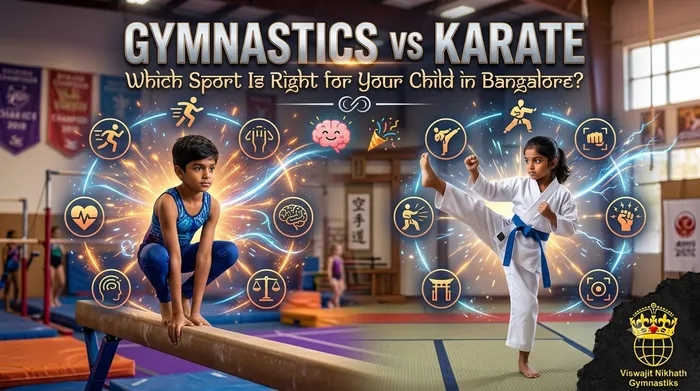
Walk into any Bangalore parenting group online and you'll find the same question on repeat: gymnastics or karate? Both are widely available across the city, both are marketed heavily on "discipline" and "confidence," and both genuinely deliver on that promise in their own way. But they build a child's body and mindset quite differently, and knowing those differences upfront will save you a few false starts.
This isn't about crowning a winner. It's about understanding what each sport actually does for a child, so you can pick the one that fits yours, or sequence both at different ages.
What Karate Builds
Karate is a striking-based martial art built around forms (kata), sparring, and a belt-ranking system. For a child, that structure translates into:
- Self-defense awareness - real techniques for blocking, striking, and situational awareness
- Respect and etiquette - bowing, addressing instructors formally, and a strong code of conduct woven into every class
- Focus through repetition - katas demand precise, repeated movement sequences, which builds sustained concentration
- Visible progress markers - belt colors give children (and parents) a clear, motivating sense of advancement
- Controlled aggression outlet - a structured, supervised way for high-energy kids to channel physical intensity
What Gymnastics Builds
Gymnastics is built around apparatus work, floor skills, and progressive body control rather than striking or sparring. For a child, that means:
- Whole-body strength and flexibility - gymnasts train strength, flexibility, balance, and coordination together, in a way few other youth sports combine
- Spatial awareness - skills like cartwheels, rolls, and beam work teach a child to understand exactly where their body is in space, which carries over into every other physical activity
- Fall safety - gymnasts are specifically trained how to fall and land safely, a skill that quietly reduces injury risk in daily life and other sports
- Individual goal-setting - progress is skill-by-skill (a child's first cartwheel, their first handstand) rather than belt-by-belt, which keeps motivation personal rather than comparative
- A foundation for other sports - the balance, coordination, and body control gymnastics builds transfers directly into almost every other athletic pursuit
Gymnastics vs Karate: A Side-by-Side Look
| Aspect | Gymnastics | Karate |
|---|---|---|
| Primary focus | Body control, strength, flexibility | Striking technique, self-defense, discipline |
| Contact level | Non-contact | Light to moderate sparring contact (age-dependent) |
| Progress markers | Skill mastery (cartwheel, handstand, routines) | Belt ranking system |
| Flexibility demand | High | Moderate |
| Best starting age | As young as 2-3 (toddler classes) | Typically 4-5 and up |
| Structure style | Apparatus-based, progressive skill circuits | Forms, drills, and sparring |
| Great for | Building an athletic foundation early | Building focus, respect, and self-defense confidence |
Which Sport Fits Your Child Better
Gymnastics may be the better starting point if your child:
- Is very young (toddler to early primary school) and you want to build general athleticism first
- Loves climbing, flipping, jumping, or is constantly testing their own physical limits at home
- Struggles with balance or coordination and could use structured, progressive body-control training
- Is interested in dance, athletics, swimming, or another sport later - gymnastics is an excellent base for almost everything
Karate may be the better fit if your child:
- Is a little older and drawn to structure, ritual, and clear, visible progress markers like belts
- Needs a constructive outlet for physical energy alongside a strong respect-and-etiquette framework
- Is specifically interested in self-defense skills
- Responds well to repetition-based learning and enjoys mastering set sequences
Can They Do Both?
Absolutely, and many Bangalore families do exactly this. Gymnastics in the early years (say, ages 3-7) builds the strength, flexibility, and body awareness that make a child a faster, more confident learner in almost any sport they pick up afterward, including karate. Starting with gymnastics and adding karate a few years later, rather than choosing one and ruling out the other permanently, is a very reasonable path if your schedule allows for two activities.
If you can only commit to one right now, let your child's personality guide the choice more than the sport's reputation. An energetic toddler who loves jumping off furniture will likely take to gymnastics faster. A slightly older child who's drawn to structure and ritual may connect more with karate.
Frequently Asked Questions
Is gymnastics or karate better for building confidence in a shy child?
Both build genuine confidence, but through different routes. Gymnastics builds confidence through private, personal milestones (a child's first handstand or cartwheel) achieved at their own pace, which can feel less intimidating for a shy child than karate's more public belt-testing and sparring format. That said, a well-run karate dojo with a patient instructor can be just as supportive - the coach's approach often matters more than the sport itself.
Which sport is safer for young children?
Gymnastics is non-contact and, at a well-run academy, heavily focused on spotting and safe landing technique, which makes it a very safe starting sport for young children. Karate involves light sparring as children progress, though reputable dojos control contact carefully for younger belts. Ask any academy, gymnastics or karate, about their specific safety protocols before enrolling.
What age should my child start gymnastics or karate?
Gymnastics classes typically start as early as age 2-3 with toddler programs, since the sport is entirely non-contact and focuses on foundational movement. Karate programs more commonly start around age 4-5, once a child can reliably follow multi-step instructions and maintain focus for structured drills.
Does gymnastics help with karate, or vice versa?
Gymnastics is a strong complementary base for karate. The flexibility, core strength, and body control gymnastics builds directly support higher kicks, better balance during strikes, and safer falls during sparring. Karate doesn't build the same physical base for gymnastics, which is why many coaches suggest starting with gymnastics first if a child is very young.
Can my child switch from karate to gymnastics later, or the other way around?
Yes, and it's common. Skills like discipline, focus, and body awareness transfer well between the two sports. A child who has trained in karate will usually already have good listening skills and body control walking into a gymnastics class, and a child with a gymnastics background will usually pick up karate's coordination and balance demands quickly.
At Viswajit Nikhath Gymnastiks, our recreational classes are designed to give your child that strong physical foundation, strength, flexibility, balance, and body awareness, in a safe, encouraging, non-contact environment. If you're weighing gymnastics against karate, we'd love to have your child try a class and feel the difference for themselves. Book a trial and see what a class at VNG is really like.