
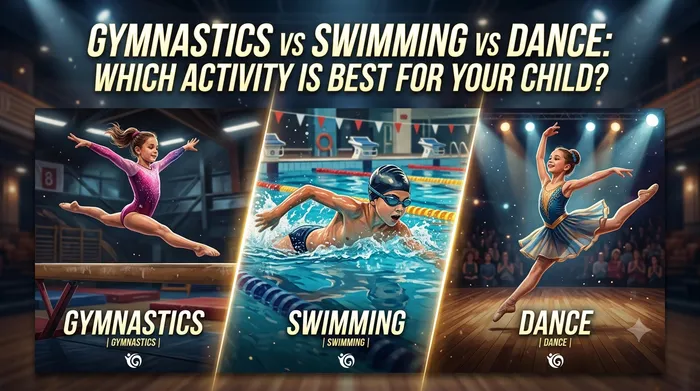
Gymnastics vs Swimming vs Dance: Which Activity Is Best for Your Child?
Parents in Bangalore often face a common decision when choosing an extracurricular activity: gymnastics vs swimming for kids, or gymnastics vs dance. Each option offers real benefits, yet they develop different qualities. Understanding the strengths of each helps families select the activity that best matches a child’s age, personality and long-term needs.
This comparison examines gymnastics, swimming and dance across key areas such as physical development, confidence, focus, social skills and practical considerations. The goal is to give parents a clear framework rather than declare one activity universally superior. Many children thrive when the chosen activity aligns with their temperament and the family’s routine.
Physical Development: Strength, Flexibility and Coordination
Gymnastics builds full-body strength through bodyweight movements. Children develop core stability, shoulder and arm strength, leg power and overall coordination. Flexibility improves through guided stretching and skill progressions. Body awareness becomes refined because every movement requires control and spatial understanding.
Swimming develops cardiovascular endurance, lung capacity and muscular endurance with low impact on joints. It strengthens the upper body, core and legs while teaching rhythmic breathing. Flexibility gains are present but usually less targeted than in gymnastics or dance.
Dance improves flexibility, posture, rhythm and lower-body strength. Different styles emphasise different elements: classical forms often prioritise alignment and control, while contemporary or freestyle styles add expression and cardiovascular work. Upper-body strength development is generally lighter than in gymnastics.
For parents seeking balanced strength, coordination and flexibility in one activity, gymnastics often provides the broadest physical foundation. Swimming excels in endurance and joint-friendly conditioning. Dance stands out for rhythmic movement and expressive flexibility.
Confidence and Emotional Growth
Confidence grows when children experience visible progress and mastery. In gymnastics, skills advance in clear stages. A child who could not hold a balance last month can now hold it steadily. These concrete achievements create a strong sense of capability. Structured classes also teach children to manage mild frustration and try again, building resilience.
Swimming builds confidence through water comfort and distance or technique milestones. Overcoming initial hesitation in water can be especially empowering for some children. Progress is often measured in laps, strokes or comfort levels.
Dance develops confidence through performance, expression and mastery of sequences. Children learn to present themselves in front of others, which supports social ease. Feedback is often artistic as well as technical.
All three activities can strengthen self-belief. Gymnastics tends to emphasise measurable physical mastery and controlled risk-taking in a safe setting. This combination frequently translates into quieter, steady confidence that appears in school and daily challenges.
Focus, Discipline and Structure
Gymnastics classes follow predictable routines with clear instructions and skill stations. Children practise listening, waiting for turns and concentrating on precise movements. The structure supports attention and self-regulation. Some programmes include tracks designed specifically to build focus through movement.
Swimming requires focus on breathing, stroke technique and lane awareness. Discipline develops through regular practice and progressive distance or skill goals. The repetitive nature of lap swimming can feel meditative for some children and monotonous for others.
Dance demands concentration on counts, formations and movement quality. Learning choreography strengthens memory and sequential thinking. Group rehearsals also teach children to stay attentive while coordinating with others.
Parents looking for strong structure and attention-building elements often find gymnastics particularly effective. The combination of physical challenge and clear progressions helps many children improve focus over time.
Social Skills and Group Dynamics
All three activities offer social interaction, yet the style differs. Gymnastics classes create opportunities for encouragement during skill practice and light teamwork in circuits or group games. Friendships form around shared effort and small successes.
Swimming can be more individual during lane work, though group lessons and team environments add social contact. Competitive swimming introduces stronger team identity.
Dance frequently emphasises group coordination, partner work and performance. Children learn to move in relation to others and share the stage, which can build strong collaborative skills.
The social atmosphere depends heavily on the specific academy or school. A positive, supportive environment matters more than the activity itself.
Practical Considerations for Bangalore Families
Location, schedule reliability and weather independence influence long-term consistency. Gymnastics takes place fully indoors, making it reliable during monsoon months when outdoor or water-based options may face disruptions. Swimming requires access to a well-maintained pool and can be affected by facility closures or water quality concerns. Dance is also indoor and generally weather-independent.
Batch size and coaching quality vary across all three activities. Smaller groups usually allow more individual feedback. Trial classes remain the best way to assess whether a child feels comfortable and engaged.
Cost structures differ by centre. Parents should compare session frequency, group size and included elements rather than looking only at monthly fees.
Matching Activity to Child Personality
Consider these broad patterns:
- Children who enjoy climbing, rolling, balancing and physical problem-solving often connect quickly with gymnastics.
- Children who love water and rhythmic, continuous movement may prefer swimming.
- Children drawn to music, expression and performance frequently thrive in dance.
Age also plays a role. Younger children often benefit from the playful, exploratory nature of introductory gymnastics or movement classes. Older children may have clearer preferences based on earlier experiences.
It is common for children to try more than one activity over the years. Starting with one strong foundation and remaining open to change is a practical approach.
How Gymnastics Fits Many Bangalore Families
When parents weigh gymnastics vs swimming for kids or gymnastics vs dance, several practical advantages of gymnastics stand out for daily life in Bangalore. Fully indoor training continues through the monsoon. Progressive skill pathways give children a clear sense of improvement. Programmes exist for toddlers, school-age children and even adults, allowing families to find suitable entry points.
Centres that keep batches small and emphasise certified coaching further support steady progress and safety. Viswajit Nikhath Gymnastiks in Kundalahalli offers recreational and progressive programmes across age groups with these principles in mind. Families can explore options on the programmes page, review kids-specific details on the kids gymnastics page, or check timings on the schedule page.
Trial classes help parents and children experience the environment directly. Questions about fees, age groups and what to expect are answered on the FAQ page. Direct contact is available through the contact page. Additional background on the coaching approach appears on the about page.
Making the Final Choice
No single activity is best for every child. The most effective extracurricular activity is the one a child attends consistently, enjoys and grows through. Use the comparison points above as a checklist:
- Physical goals (strength, endurance, flexibility, coordination)
- Personality and preference
- Need for structure and focus support
- Schedule reliability and location
- Quality of coaching and group size
- Long-term enjoyment potential
Visit centres, observe classes when possible, and listen to how your child responds after a trial session. The right choice usually feels clear once you see the child in the actual environment.
Conclusion
Gymnastics, swimming and dance each offer valuable benefits for children. Gymnastics provides broad physical development, clear skill progressions and strong indoor reliability. Swimming delivers excellent cardiovascular conditioning and water confidence. Dance develops rhythm, expression and performance skills.
When comparing gymnastics vs swimming for kids or gymnastics vs dance, consider your child’s temperament, your family’s practical constraints and the specific quality of the local programmes available. The best extracurricular activity for children is the one that builds both physical capability and quiet confidence while fitting sustainably into daily life.
Take time to explore options, ask questions and allow your child to experience a class. A thoughtful decision at the start creates the foundation for years of positive movement and growth.