
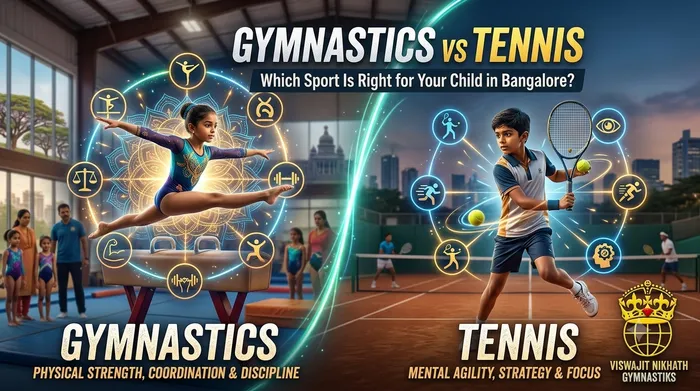
If you're a parent in Bangalore weighing up extracurricular activities, gymnastics and tennis probably both made your shortlist. Both are popular, both build real athleticism, and both show up constantly in conversations at school gates and parent WhatsApp groups. But they develop very different skills, suit different personalities, and ask different things of your family's time and budget.
At VNG, we get asked this question often by parents who are searching for gymnastics classes near me but also considering a racquet sport for their child. Here's a clear-eyed comparison to help you decide, without any bias toward "our sport is better."
What Each Sport Actually Builds
Gymnastics and tennis both develop coordination and discipline, but the foundations they lay are quite different.
Gymnastics is fundamentally about building the body's core physical literacy:
- Full-body strength, especially core, shoulders, and legs
- Flexibility and joint mobility
- Balance and spatial awareness
- Body control in the air (landing safely, controlling rotation)
- Discipline through structured, repeatable skill progressions
Tennis is fundamentally about building sport-specific reflexes and strategy:
- Hand-eye coordination and reaction speed
- Footwork and lateral movement
- Strategic thinking (shot selection, reading an opponent)
- Stamina for longer, sustained rallies and matches
- Mental resilience under one-on-one competitive pressure
A useful way to think about it: gymnastics builds the physical foundation that almost any sport later benefits from, while tennis builds a specific competitive skill set for a sport your child can play for life.
Age and Starting Point
Gymnastics has an advantage for younger children. Most academies, including VNG, welcome toddlers from around age 2-3 into structured movement classes, well before most tennis programs will take a child on court. Tennis typically becomes meaningful from around age 5-6, once a child has the coordination and attention span to track and return a ball consistently.
If you're looking to start your child in an activity early, gymnastics is usually the easier entry point. If your child is already a bit older and shows interest in ball sports, tennis can be a great starting sport in its own right.
Comparing the Two Sports at a Glance
| Factor | Gymnastics | Tennis |
|---|---|---|
| Ideal starting age | 2-3 years and up | 5-6 years and up |
| Type of activity | Individual, self-paced skill building | Individual or doubles, competitive |
| Weather dependency | Indoor, unaffected by rain or heat | Often outdoor courts, weather-dependent |
| Core benefit | Strength, flexibility, body control | Reflexes, footwork, strategic thinking |
| Equipment needed | Minimal (provided by academy) | Racquet, balls, court fees, shoes |
| Competitive pathway | Levels, state and national meets | Ranked tournaments, school and club leagues |
| Injury profile | Overuse injuries if progressed too fast | Wrist, elbow, and ankle strain |
Which Suits Your Child's Personality?
Think about how your child naturally plays and moves.
- If your child loves flipping on the sofa, climbing everything in sight, and seems to have endless energy for movement without needing an opponent, gymnastics is likely to hold their attention.
- If your child is drawn to games with a clear winner, enjoys the back-and-forth of competition, and likes the idea of a rally or a match, tennis may be a more natural fit.
- If your child is naturally quieter or takes time to warm up to new environments, gymnastics classes tend to feel less pressured at first, since progress is measured against your own child's previous skills, not an opponent across the net.
Many families find that a child's early interests shift as they grow, so don't treat this as a permanent decision.
Practical Considerations for Bangalore Parents
Bangalore's weather and traffic genuinely factor into this choice more than people expect.
- Indoor training matters during monsoon. Gymnastics happens entirely indoors at a facility like VNG, so classes run uninterrupted through Bangalore's long rainy stretches. Outdoor tennis courts often get waterlogged or unusable for days at a time.
- Court and coaching access varies by locality. Quality tennis coaching is concentrated around a smaller number of clubs and academies across the city, which can mean a longer commute depending on where you live, whereas gymnastics academies have grown more widely across neighbourhoods like Whitefield, Marathahalli, and Brookefield.
- Ongoing costs differ. Tennis usually involves recurring costs for court time, coaching, and gear beyond the monthly class fee, while gymnastics fees tend to be more predictable since equipment stays at the facility.
Can Your Child Do Both?
Absolutely, and many parents choose exactly this. A child who does gymnastics for a year or two first often arrives at tennis with better balance, footwork, and body awareness, which can genuinely accelerate how quickly they pick up racquet skills. If your child has the time and enthusiasm for it, an early foundation in gymnastics followed by (or alongside) tennis is a strong combination rather than a trade-off.
Frequently Asked Questions
Is gymnastics a good foundation before starting tennis?
Yes. Gymnastics builds core strength, balance, and body control at a young age, all of which transfer directly into better footwork and coordination once a child picks up a racquet. Many coaches consider early gymnastics training a strong base for almost any sport that comes later, tennis included.
At what age should my child start gymnastics if we're in Bangalore?
Most academies, including VNG, welcome children from around age 2-3 into parent-assisted or beginner classes, with more structured skill-based training typically starting around age 4-5. Starting early helps children build coordination and confidence before formal sports like tennis usually begin.
Is tennis or gymnastics better for a shy child?
Gymnastics is often gentler for shy or reserved children since progress is measured against their own previous skills rather than head-to-head against an opponent. That said, some shy children do open up through the structured, one-on-one nature of tennis coaching, so it really depends on the individual child.
How much time commitment does each sport need weekly?
Most beginner gymnastics programs run 1-2 classes a week of around 45-60 minutes each. Tennis often starts similarly but tends to add more time as a child progresses, since rallying and match play both take longer than a typical gymnastics drill.
Can my child switch from tennis to gymnastics later, or vice versa?
Yes, and it's common. Many of the foundational skills, like balance, coordination, and discipline, carry over between sports. Switching later doesn't put a child at a disadvantage, especially if they've built a solid physical base in either sport first.