
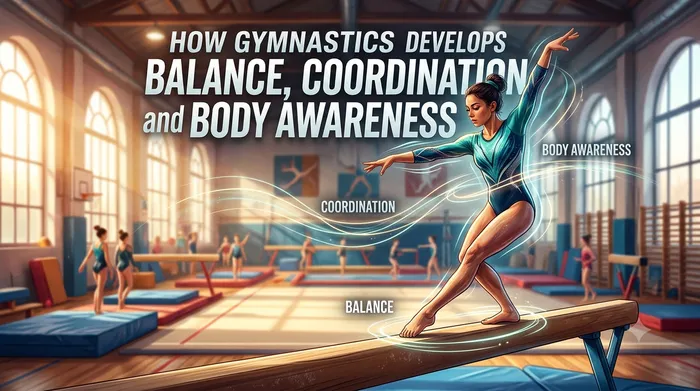
How Gymnastics Develops Balance, Coordination, and Body Awareness
Balance, coordination and body awareness form the foundation of almost every physical skill a child will ever use. From writing and playing sports to simply moving through a crowded space, these abilities influence daily life. Gymnastics is one of the most effective activities for developing all three at the same time.
This article explains how gymnastics trains these qualities, why they matter for children, and what parents can expect from structured classes. The focus stays practical so families in Bangalore can understand the real value of regular training.
Core idea: Body awareness in children improves when they repeatedly practise controlled movement with clear feedback. Gymnastics provides exactly that environment.
Understanding the Three Skills
Balance is the ability to maintain control of the body’s position, whether still or moving. It relies on the inner ear, vision, muscle feedback and core strength.
Coordination is the smooth working together of different body parts and the senses. It allows a child to run and catch, write neatly, or climb efficiently.
Body awareness (also called proprioception) is the sense of where the body is in space without needing to look. Children with strong body awareness move more confidently and with less clumsiness.
These three skills support each other. Better balance improves coordination. Stronger coordination sharpens body awareness. Gymnastics trains them together through progressive, purposeful movement.
How Gymnastics Trains Balance
Almost every gymnastics skill challenges balance in a controlled way.
- Walking on a low beam teaches children to adjust their posture and focus their gaze.
- Holding static shapes (such as a scale or arabesque) builds the small stabilising muscles around the ankles, hips and core.
- Landing from jumps and skills requires children to absorb force and regain control quickly.
- Inverted positions (such as supported handstands) retrain the balance system in new orientations.
Because skills are broken into small steps, children experience success early and then face gradually harder balance challenges. This progressive loading is more effective than random play for long-term improvement.
Coordination Exercises for Kids Inside Gymnastics Classes
Gymnastics classes are full of natural coordination exercises for kids. Unlike isolated drills, these exercises sit inside meaningful skills that children want to learn.
Common examples include:
- Rolling sequences that require timing of the head, arms and hips
- Cartwheel progressions that demand opposite-side arm and leg coordination
- Jump and land patterns that link lower-body power with upper-body control
- Bar swings and hangs that coordinate grip, core and timing
- Simple routines that string several movements together in sequence
Each of these activities forces the brain and body to work as a team. Over weeks and months, the nervous system becomes more efficient at organising movement. Children often appear less clumsy and more fluid in everyday activities as a result.
Building Body Awareness in Children
Body awareness develops when children receive clear sensory feedback from their muscles and joints while moving with intention. Gymnastics supplies this feedback constantly.
When a coach says “squeeze your core” or “reach longer through your fingers,” the child must locate and control specific body parts. Holding a shape for a few seconds deepens the sensory map of that position. Moving from one shape to another teaches the child how body parts relate to each other in space.
Strong body awareness in children shows up as:
- Better posture
- Improved handwriting and fine motor control
- Greater confidence on playground equipment
- Reduced frequency of trips and bumps
- Faster learning of new sports skills later on
Parents frequently notice these changes even outside the gym.
Why Structured Classes Work Better Than Free Play Alone
Free play is valuable. Children need unstructured time to explore. However, free play alone rarely provides the systematic progression that produces reliable gains in balance, coordination and body awareness.
Structured gymnastics classes add three important ingredients:
- Expert progression – skills are taught in an order that builds safely and effectively.
- Specific feedback – coaches correct alignment and timing in the moment.
- Repetition with purpose – children practise the same fundamental patterns until they become automatic.
The combination of exploration and guided refinement accelerates development.
Age-Related Development Patterns
Ages 2–4
Toddlers focus on basic balance, climbing and spatial exploration. Classes remain playful while introducing simple body control.
Ages 4–8
This window is ideal for rapid gains in coordination and body awareness. Children can follow multi-step instructions and enjoy measurable skill progress.
Ages 9–12
Strength and more complex coordination patterns develop quickly. Children refine earlier skills and link them into longer sequences.
Teen years
Focus shifts toward refinement, strength and personal goals. Body awareness continues to improve with consistent training.
Starting at any of these stages can still produce meaningful benefits. Consistency matters more than perfect starting age.
Practical Benefits Parents Often Observe
After several months of regular training, many families report:
- Improved posture both sitting and standing
- Greater ease on stairs, playgrounds and in sports
- Better ability to learn new physical skills quickly
- Increased confidence in movement
- Reduced clumsiness or frequent minor bumps
These outcomes support both physical education at school and everyday independence.
Supporting Development at Home
Parents can reinforce class work with simple habits:
- Encourage barefoot play when safe to strengthen foot muscles and sensory feedback.
- Allow climbing and balancing on age-appropriate playground equipment.
- Play games that involve copying movements or balancing on one foot.
- Avoid constant verbal correction during free play so children can explore.
The goal is to complement, not replace, structured training.
What to Look for in a Quality Programme
Effective development of balance, coordination and body awareness depends on good coaching and appropriate class design.
| Element | Why It Helps |
|---|---|
| Small batch size | Allows individual corrections and feedback |
| Progressive curriculum | Builds skills in a logical, safe order |
| Certified coaches | Ensures correct technical input |
| Age-appropriate groups | Matches challenges to developmental stage |
| Adequate mat and equipment quality | Supports safe exploration of balance and control |
Centres that prioritise these elements create better conditions for lasting physical literacy. You can explore programmes designed around progressive skill development on the programmes page and the kids gymnastics page.
Current class timings are listed on the schedule page. Practical questions about starting appear on the FAQ page. To arrange a trial or discuss your child’s stage, visit the contact page. Background on the coaching approach is available on the about page.
Conclusion
Gymnastics develops balance, coordination and body awareness through purposeful, progressive movement under expert guidance. These three qualities form the base for almost every other physical skill a child will learn.
By combining clear skill progressions, specific feedback and regular practice, gymnastics provides some of the most effective coordination exercises for kids available. At the same time it strengthens body awareness in children in ways that transfer to school, play and daily life.
For parents seeking an activity that builds fundamental physical competence, structured gymnastics offers a proven and enjoyable path. Consistent training in a well-run academy helps children move with greater control, confidence and ease — skills that serve them far beyond the mat.