
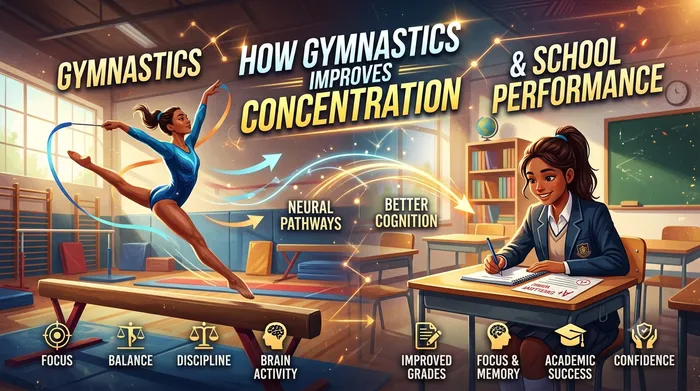
How Gymnastics Improves Concentration and School Performance
Many parents notice that children who train regularly in structured physical activities often show better attention in class and improved schoolwork. Among these activities, gymnastics stands out for its strong connection to focus and self-regulation. The relationship between gymnastics and concentration is not accidental. The skills practised on the mat transfer directly to the classroom.
This article explains how gymnastics for focus works, the mechanisms that link movement to better attention, and why many families in Bangalore consider it a valuable support for academics. The goal is to give parents clear, practical insight rather than general claims.
Key insight: Gymnastics does not replace good teaching or study habits. It strengthens the underlying attention, memory and emotional control that make learning easier.
The Science Behind Movement and Attention
Physical activity influences the brain in several well-documented ways. Aerobic movement increases blood flow and supports the release of chemicals that aid focus and mood. Complex, coordinated movements go further. They require the brain to process spatial information, sequence actions and make rapid adjustments.
Gymnastics combines both elements. Children perform dynamic movements while maintaining precise control. Each skill demands sustained attention: where the hands go, how the body aligns, when to push or hold. This repeated practice strengthens the neural networks involved in concentration.
Over time, children become better at directing their attention deliberately. That skill does not stay on the mat. It appears during lessons, homework and even everyday conversations.
How Gymnastics Trains Focus in Practice
A typical gymnastics class follows a clear structure. Children move through warm-up, skill stations, strength work and a short closing activity. At each stage they must listen to instructions, wait for their turn and concentrate on specific body positions.
This environment creates natural focus training:
- Short, clear tasks keep attention manageable for younger children.
- Immediate feedback from coaches helps children adjust quickly.
- Progressive challenges require increasing levels of concentration as skills become more complex.
- Predictable routines reduce anxiety and free mental energy for learning.
Children who struggle with open-ended or long periods of sitting often respond well to this format. The physical nature of the work makes sustained attention feel more achievable.
Specific Links Between Gymnastics and Academics
Research and classroom observation point to several pathways through which gymnastics supports school performance.
Improved Working Memory
Many gymnastics skills require children to hold a sequence of movements in mind while executing them. This strengthens working memory, the ability to keep and manipulate information over short periods. Working memory is essential for following multi-step instructions, solving maths problems and reading comprehension.
Better Impulse Control
Waiting for a turn, holding a shape, or resisting the urge to rush a skill builds inhibitory control. Children practise pausing and choosing the right action. This capacity helps in classroom settings where students must raise a hand, stay in their seat or complete work before moving on.
Enhanced Spatial Awareness
Gymnastics constantly engages spatial processing. Children learn where their body is in space and how to move it accurately. Stronger spatial skills support subjects such as geometry, science diagrams and even handwriting.
Stress Regulation
Physical activity helps regulate the stress response. Children who train regularly often arrive at school in a calmer physiological state. Lower baseline stress makes it easier to concentrate and retain new information.
These connections explain why the phrase “gymnastics and academics” appears increasingly in discussions about whole-child development.
Age Considerations and Realistic Expectations
The benefits appear across age groups, yet the expression differs.
- Younger children (ages 4–8) often show improved ability to follow instructions and sit for short focused periods.
- Older children (ages 9–12) frequently demonstrate better homework persistence and ability to manage multi-step tasks.
- Teenagers may notice stronger self-discipline and improved capacity to study for longer stretches.
Results are not instant. Most parents and coaches observe clearer changes after several weeks or months of consistent training. Attendance matters more than intensity at the beginning.
Supporting Children Who Need Extra Focus Help
Some children find concentration especially challenging. For them, the structured, predictable nature of gymnastics can be particularly helpful. Short skill stations, clear expectations and physical engagement create an environment where attention can grow gradually.
Certain programmes design classes specifically around focus and self-esteem. These sessions keep groups small and routines consistent so children experience success without feeling overwhelmed. Details of one such approach are available on the ADHD support programme page.
What Parents Can Do to Maximise the Benefits
Physical training works best when supported at home:
- Maintain consistent attendance so the brain receives regular practice.
- Ask your child about specific skills they are working on. Talking through the steps reinforces sequencing and memory.
- Avoid overloading the weekly schedule. Fatigue reduces the attention benefits.
- Share observations with both the gymnastics coach and the class teacher when relevant. Coordinated support helps the child more than isolated efforts.
- Celebrate effort and improvement in focus, not only physical achievements.
A calm, encouraging home environment amplifies the gains made in class.
Choosing a Programme That Supports Concentration
Not every gymnastics class delivers the same cognitive benefits. Look for these features:
| Feature | Why It Matters for Focus |
|---|---|
| Small batch size (8–14) | More individual feedback and less chaos |
| Clear class structure | Predictability reduces mental load |
| Progressive skill system | Builds attention through achievable steps |
| Patient, certified coaches | Correct guidance prevents frustration |
| Age-appropriate grouping | Tasks match developmental stage |
Centres that emphasise these elements create better conditions for concentration growth. You can explore programmes built around progressive, structured training on the programmes page and the kids gymnastics page.
Current timings are listed on the schedule page. Practical questions about starting, fees and expectations appear on the FAQ page. To discuss your child’s specific needs or book a trial, visit the contact page. Background on the overall coaching approach is available on the about page.
Realistic Outcomes Parents Often Notice
Families frequently report changes such as:
- Better ability to start and finish homework without constant reminders
- Improved listening during lessons
- Greater willingness to attempt challenging school tasks
- Calmer behaviour after physical activity
- Increased confidence that spills into classroom participation
These outcomes vary by child. The common thread is that regular, well-coached gymnastics strengthens the mental skills that support learning.
Conclusion
The link between gymnastics and concentration is grounded in how the brain responds to complex, controlled movement. Gymnastics for focus works because it trains attention, working memory, impulse control and stress regulation in a physical context that many children find engaging.
When these skills improve, school performance often follows. Children become better equipped to listen, remember, persist and manage the demands of the classroom. Gymnastics and academics therefore support each other rather than compete for time.
For parents seeking an activity that develops both body and mind, structured gymnastics offers a practical path. Consistent training, good coaching and a supportive environment create the conditions for lasting gains in concentration and confidence.
If you are considering gymnastics as a support for your child’s focus and schoolwork, start with a trial class and observe how your child responds. The combination of movement and mental training can become one of the most effective tools in your child’s development toolkit.