
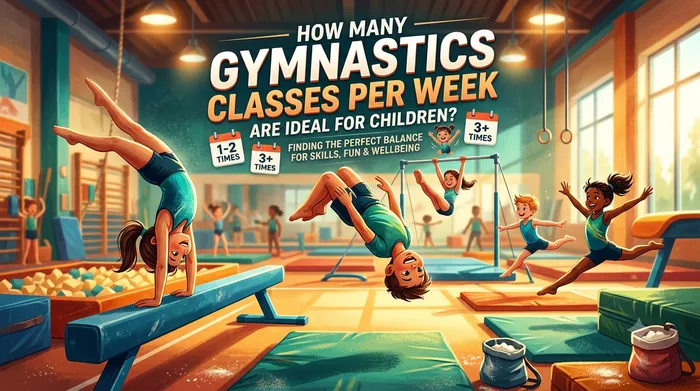
How Many Gymnastics Classes Per Week Are Ideal for Children?
Parents often ask how many gymnastics classes per week their child should attend. Too few sessions can slow progress. Too many can lead to fatigue or loss of enjoyment. The right number depends on the child’s age, goals, energy levels and the type of programme.
This guide explains practical recommendations for a balanced gymnastics schedule for kids. It covers recreational training, pre-competitive pathways and signs that the current load may need adjustment.
Core principle: Consistency over intensity produces the best long-term results for most children.
General Guidelines by Training Goal
Recreational Gymnastics
For children who train mainly for fitness, coordination, confidence and enjoyment, one to two classes per week is usually ideal.
- One class per week maintains basic skills and provides a regular physical outlet.
- Two classes per week allows clearer progress while still leaving time for school, free play and family life.
Many recreational programmes in Bangalore structure monthly packages around eight sessions, which averages two classes per week. This frequency suits the majority of school-age children.
Pre-Competitive and Competitive Training
Children moving toward higher skill levels or competition generally need more frequent training.
- Pre-competitive: often two to three classes per week
- Competitive: three or more classes per week, sometimes with additional conditioning
These higher volumes should be introduced gradually and only when the child shows clear interest and physical readiness. Recovery time remains important.
Age-Based Considerations
Ages 4–6
One class per week is often enough at the beginning. Young children tire more quickly and benefit from variety in their weekly activities. Once they settle and enjoy the class, two sessions can work well.
Ages 7–10
Two classes per week is a common and effective range for recreational training. Children at this stage can handle slightly higher volume and usually show noticeable skill gains with consistent attendance.
Ages 11–14
Two to three classes per week supports continued progress. Children who enjoy the sport and manage school demands well can sustain this load. Monitoring energy and mood becomes more important as academic pressure increases.
Teenagers
Frequency depends heavily on goals. Recreational teens may stay at one or two sessions. Those in competitive tracks often train more frequently, always with attention to recovery and overall workload.
Why Two Classes Per Week Works Well for Most Children
Two weekly sessions strike a practical balance for many families:
- Skills have time to consolidate between classes
- Children maintain momentum without feeling overwhelmed
- School, homework and free play still fit comfortably
- Risk of overuse fatigue stays lower
- Enjoyment tends to remain higher over months and years
A gymnastics schedule for kids built around two quality sessions often produces steadier long-term adherence than ambitious high-volume plans that later lead to dropout.
Factors That Influence the Ideal Number
Several individual factors should guide the final decision:
- Energy and recovery – Does the child still feel fresh and positive after classes?
- School load – Heavy exam periods may call for temporary reduction
- Other activities – Multiple sports increase total physical demand
- Interest level – A child who asks to go more often may be ready for an extra session
- Sleep and mood – Persistent tiredness or irritability can signal that volume is too high
- Coaching feedback – Experienced coaches notice when a child is ready for more (or needs less)
Open communication between parents, child and coaches produces the best adjustments.
Signs the Current Schedule May Need Changing
Consider increasing frequency if:
- The child consistently asks for more training
- Skills are stagnating despite good effort
- Energy and enthusiasm remain high
- School and sleep are unaffected
Consider reducing or holding steady if:
- The child seems unusually tired or irritable
- Enthusiasm drops noticeably
- Schoolwork or sleep begins to suffer
- Minor aches appear more often
- The child starts resisting attendance
Temporary reductions during busy school periods are normal and healthy.
Quality Matters More Than Quantity
One well-coached class in a small group with clear progressions is more valuable than several rushed or overcrowded sessions. Look for:
- Small batch sizes (ideally 8–14 children)
- Certified, attentive coaches
- Progressive skill development
- Adequate warm-up and cool-down
- Positive, encouraging atmosphere
These elements allow children to make meaningful progress even on a moderate weekly schedule.
Building a Sustainable Gymnastics Schedule for Kids
A practical weekly framework for most recreational children looks like this:
- Two gymnastics classes spaced a few days apart
- Plenty of free play and outdoor time
- Adequate sleep
- Balanced school and family commitments
Spacing classes (for example, Tuesday and Friday or Wednesday and Saturday) gives the body recovery time and helps skills settle.
During monsoon or exam seasons, many families keep the same frequency because indoor gymnastics remains reliable when outdoor activities become difficult.
Local Practicalities in Bangalore
Centres in areas such as Kundalahalli, Whitefield and the ITPL corridor often offer flexible weekly timings that support one or two sessions comfortably. Fully indoor facilities mean the gymnastics schedule for kids stays consistent year-round.
You can review available programmes and age groups on the programmes page and the kids gymnastics page. Current class timings appear on the schedule page.
Common questions about frequency, fees and starting are answered on the FAQ page. To discuss your child’s age and goals or to book a trial, use the contact page. Further background on the training approach is available on the about page.
Sample Weekly Approaches
Beginner recreational (ages 5–8)
- 1–2 classes per week
- Focus on enjoyment and foundations
Established recreational (ages 8–12)
- 2 classes per week
- Steady skill and strength development
Pre-competitive interest
- 2–3 classes per week
- Gradual increase only with sustained motivation
These are starting points, not rigid rules. Individual adjustment is always possible.
Long-Term Perspective
Children who train at a sustainable frequency for years usually develop stronger physical literacy and a more positive relationship with the sport than those who train at high volume for a short period and then stop. Enjoyment and consistency are the real drivers of lasting benefit.
Parents should periodically review the schedule with both the child and the coaches. What works at age six may need updating at age ten. Flexibility keeps the experience positive.
Conclusion
The ideal number of gymnastics classes per week for most children sits between one and two for recreational training, with higher frequencies reserved for those who show clear readiness and interest in more advanced pathways. A thoughtful gymnastics schedule for kids prioritises consistency, recovery, enjoyment and overall life balance.
Start with a realistic frequency, observe how your child responds, and adjust gradually. Quality coaching in a supportive environment allows meaningful progress even on a moderate weekly load.
If you are planning your child’s training, consider a trial class to experience the coaching style and class structure firsthand. From there, you and the coaches can decide the frequency that best supports steady development and long-term enjoyment.