
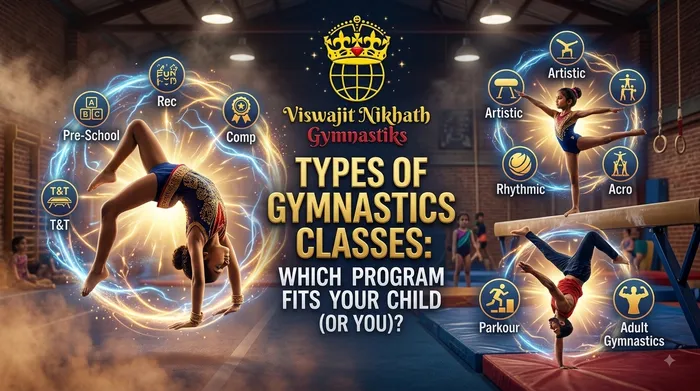
Search for gymnastics classes in Bangalore and you'll find the term used to cover everything from a 30-minute toddler play session to a 10-hour-a-week competitive training block. That's confusing if you're trying to figure out what to actually sign up for. The good news is that almost every gymnastics academy, including ours, organises its classes into a handful of recognisable formats - and once you know what each one is for, picking the right one becomes a lot easier.
The Main Types of Gymnastics Classes
Toddler / Parent-and-Child Classes
Designed for roughly ages 2 to 4, these classes are built around play-based movement rather than formal skill-building. A parent or caregiver is often on the floor with the child, guiding them through balance beams, soft rolls, and simple climbing. The goal isn't gymnastics skill at this age - it's coordination, following instructions, and getting comfortable moving independently.
Recreational Classes
The most common format, and what most people mean when they say "gymnastics classes." Kids are grouped roughly by age and ability, rotating through apparatus - floor, beam, bars, vault - in a class of typically 45 to 60 minutes, once or twice a week. Recreational classes are non-competitive by design: the point is steady, well-rounded skill development, fitness, and confidence, not qualifying for meets.
Pre-Competitive and Competitive Classes
For gymnasts who show strong aptitude and want to go further, pre-competitive classes increase training volume and narrow the focus to specific named skills a coach is preparing them to compete. These sessions run longer, happen more days a week, and involve much more individual coaching attention per gymnast. This path isn't for everyone, and a good academy will suggest it rather than push every recreational gymnast toward it.
One-to-One / Private Classes
A dedicated coach working with a single gymnast, usually to accelerate progress on a specific skill, rebuild confidence after a setback, or fit a schedule that group classes don't accommodate. Private classes cost more per session but compress the attention a gymnast would otherwise share with 6-10 peers into one-on-one time.
Adult Classes
Structured specifically for beginners aged 18 and up, adult classes drop the assumption of childhood flexibility and build strength, mobility, and foundational skills at a pace suited to adult bodies and adult schedules (often evenings or weekends). Nobody is expected to already do a cartwheel on day one.
Comparing the Formats
| Class type | Typical age | Group size | Weekly commitment | Best for |
|---|---|---|---|---|
| Toddler / parent-child | 2-4 yrs | Small group + caregiver | Once a week | Early coordination, following instructions |
| Recreational | 5-14 yrs | Small-medium group | 1-2 sessions | Well-rounded skill building, fitness, fun |
| Pre-competitive / competitive | 6+ yrs (by aptitude) | Small group | 3+ sessions | Gymnasts pursuing meets and higher-level skills |
| One-to-one | Any age | Individual | Flexible | Targeted skill work, confidence rebuilding, tight schedules |
| Adult | 18+ | Small group | 1-2 sessions | Beginners building strength and flexibility later in life |
How to Choose Between Them
A few questions make this decision much easier than it looks on paper:
- What does your child (or you) actually want out of it? Fun and fitness point toward recreational classes. A specific goal, like preparing for a competition, points toward pre-competitive coaching. A tight or unusual schedule points toward one-to-one.
- How much time can you realistically commit each week? Competitive-track training is a real time investment for the whole family, not just the gymnast. Be honest about what's sustainable before signing up for the more intensive option.
- Does the child need extra confidence before joining a group? Some kids do better easing in with a few private sessions before joining a recreational batch, especially if they're naturally shy in new group settings.
- Is this a first exposure to gymnastics at all? If so, start with recreational (or toddler, if age-appropriate) rather than jumping straight to private coaching - a general foundation makes later specialised coaching far more effective.
Many gymnasts also move between formats over time. It's common to start recreational, add a private session or two to work on a sticking point, and later shift into pre-competitive training if both the gymnast and the coach see the aptitude and interest for it. None of these are one-way doors.
Frequently Asked Questions
What's the difference between recreational and competitive gymnastics classes?
Recreational classes focus on well-rounded skill-building and fitness without the goal of competing, while competitive classes involve higher weekly training volume and a coach actively preparing the gymnast for specific meets and skill levels.
Can a child switch from recreational to competitive classes later?
Yes, this is a common and normal path. Coaches typically identify aptitude and interest during recreational training and suggest moving up when it makes sense, rather than requiring a decision on day one.
Are one-to-one gymnastics classes worth the extra cost?
They're most worth it for a specific, time-limited goal, such as breaking through a plateau on one skill or rebuilding confidence after a fall, rather than as a full replacement for ongoing group classes.
What type of class should a complete beginner start with?
Most complete beginners, whether a young child or an adult, should start with a recreational (or toddler, if age-appropriate) class rather than private coaching, since a broad foundation makes any later specialised training more effective.
Do adult gymnastics classes assume prior experience?
No. Adult classes are built for beginners and progress at a pace suited to adult bodies, with no assumption of childhood flexibility or prior gymnastics background.
If you're still not sure which format fits, the simplest next step is a trial class - it tells you far more in 45 minutes than any comparison chart can.